I wanted to point people's attention to the blog Landlord Rescue, a fun blog to read on the trials and tribulations of a professional landlord in Ontario.
With BC property sales relatively weak (the pace for June sales is lower than May's; in strong markets it's almost always the opposite) but borrowing rates still relatively low compared to the 15 year average, we are likely to see many investors make a longer term commitment to become part-time landlords. Many if not most will find cash flows to be stable with little hassle. While they may not be making an exceptional return if they bought at recent prices, they won't necessarily have negative monthly carrying costs. It is certain, however, a select few will be stuck with significant problems. On average, revenue from real estate is less than headline rent and expenses more than regular maintenance and taxes, which is why professional landlords typically require some premium to account for this aggregated risk.
If you are thinking of renting out a property, it's worth considering what can and does happen every day to landlords. Perhaps reading Landlord Rescue concentrates too much on the fringe cases but, at least, I hope it gives some idea of what some landlords -- and not just the professionals -- will face in the coming years.
Thursday, June 10, 2010


Wednesday, June 02, 2010
FVREB May 2010 Statistics
The Fraser Valley Real Estate Board has released the statistics package for May 2010 and here are the details.
Sales were 1477.
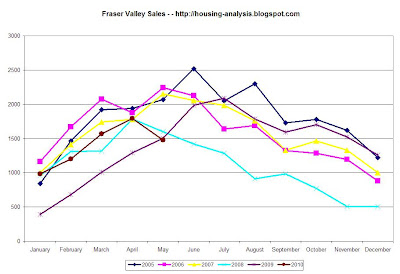
Active Listings were 11,411 at the end of May.

Months of Inventory rose significantly to 7.7 MOI which puts the FV solidly into price decline territory.

The MOI relationship with price changes is extremely robust as evidenced by May with a MOI of 7.7 and a price decline of -0.8 for the benchmark of all residential properties changing hands in the month.

I expect MOI will climb much higher this year and prices look set to decline dramatically.
Sales were 1477.

Active Listings were 11,411 at the end of May.

Months of Inventory rose significantly to 7.7 MOI which puts the FV solidly into price decline territory.

The MOI relationship with price changes is extremely robust as evidenced by May with a MOI of 7.7 and a price decline of -0.8 for the benchmark of all residential properties changing hands in the month.

I expect MOI will climb much higher this year and prices look set to decline dramatically.

Saturday, May 29, 2010
Teranet HPI for March 2010
| ||||||||||||||||||||||||||||||||||||||||||||||||||
Toronto prices were flat in March. Prices were up 0.1% in Ottawa, 0.6% in Montreal and Vancouver and 1.4% in Halifax. The broad slowing of monthly gains is consistent with a general loosening of resale-market conditions across the country. For some months now, homes have been coming on the market faster than they have been selling. Of the six metropolitan markets surveyed, Calgary remains the only one that has yet to top its pre-recession high. Its prices are down 10.3% from their peak of August 2007. Teranet – National Bank House Price Index™
The historical data of the Teranet – National Bank House Price Index™ is available at www.housepriceindex.ca.
The Teranet–National Bank House Price Index™ is estimated by tracking observed or registered home prices over time using data collected from public land registries. All dwellings that have been sold at least twice are considered in the calculation of the index. This is known as the repeat sales method; a complete description of the method is given at www.housepriceindex.ca
Teranet - National Bank House Price Index™ thanks the author for their special collaboration on this report. 1 Value of Dwelling for the Owner-occupied Non-farm, Non-reserve Private Dwellings of Canada. |


Tuesday, May 25, 2010
RBC Housing Affordability
The conclusion - Houses are not afforable
http://www.rbc.com/economics/market/pdf/house.pdf
British Columbia — Unaffordable and becoming riskier
Rapid price increases are quickly undoing last year’s improvement in affordability in British Columbia. In the first quarter, RBC affordability measures surged between 0.9 and 4.0 percentage points, by far the sharpest deterioration among the provinces. In the past three quarters, the measures reversed between one-third and one-half of their sharp drop in 2008 and early 2009. B.C. housing markets have been on a tear since last summer – with resale activity fully recovering to predownturn levels by the end of 2009 – although some signs of slowing have emerged since the beginning of this year. Nonetheless, the strong price momentum has continued largely unaffected in recent months, returning RBC affordability measures closer to their all-time highs in early 2008. Such poor affordability levels represent an element of risk for the province’s markets.
Risk - in real estate - say it ain't so.
http://www.rbc.com/economics/market/pdf/house.pdf
British Columbia — Unaffordable and becoming riskier
Rapid price increases are quickly undoing last year’s improvement in affordability in British Columbia. In the first quarter, RBC affordability measures surged between 0.9 and 4.0 percentage points, by far the sharpest deterioration among the provinces. In the past three quarters, the measures reversed between one-third and one-half of their sharp drop in 2008 and early 2009. B.C. housing markets have been on a tear since last summer – with resale activity fully recovering to predownturn levels by the end of 2009 – although some signs of slowing have emerged since the beginning of this year. Nonetheless, the strong price momentum has continued largely unaffected in recent months, returning RBC affordability measures closer to their all-time highs in early 2008. Such poor affordability levels represent an element of risk for the province’s markets.
Risk - in real estate - say it ain't so.
Wednesday, May 19, 2010
I'll Just Sell
In my work, coming face to face with hundreds of people each year, discussing finances and attitudes about finances, I find it very interesting how people approach potential financial pitfalls and opportunities.
One situation I have often come across quite often is the approach toward real estate ownership and financial risk management. The risks I speak of are common to all people: Death, Divorce, and / or a Loss of Income. One of these things can happen unexpectedly at any time and how you prepare for these events is of critical importance in your and your family's long term financial health. Relating specifically to real estate ownership, what happens to the family home when one of these risks turns into reality. How will the mortgage, taxes, maintenance, fees get paid?
Death - a common answer with a couple is "I'll just sell if Bill dies." or "We'll find a way to make it work." - a poor strategy to be sure and one frought with risks. What if the sale price is below what you need? What if it takes 6, 12, 18 months to sell? Where will you live? Will you be in any state to move and uproot in a time of emotional turmoil? Will you have the financial capacity and physical capability to make the necessary payments are do the necessary maintenance? Life insurance is a more appropriate strategy and the costs of that insurance should be added to the monthly budget.
Divorce - this clearly never happens to anyone and certainly isn't going to happen to the couple in front of me! "We'd just sell and split the proceeds." is the typical answer but this is also full of pitfalls. What if one person is emotionally attached to the property? What if one person wants to sell for much more than the other person and there is a stalemate about the sale strategy (very common)? Will you be in any state to move and uproot in a time of emotional turmoil? The key to managing this risk probably lies in the mate selection process but more practical advice would be that couples shouldn't overextend themselves beyond what either of them is comfortable taking on by themselves if it became necessary.
Loss of Income - Job loss or a disability can happen any time as well and despite the loss of income, the bank, strata, government still wants to be paid all at a time of diminished capacity to meet these demands. The common answer here again is "I'll just sell." but again will you be able to sell? Or more appropriately, will you be able to sell it quickly at the price you want? This is really the key question, since you can always sell your home if price isn't a consideration, but it always is. If you lose your job or become disabled, do you have enough of a financial cushion to make all of the necessary payments for 12 - 18 months or longer? Again, disability insurance can be helpful here but it is no solution for job loss. The best advice to to have a large cushion of savings that you can draw on if necessary. Retirement savings withdrawals are possible as long as you commit to replacing the funds as soon as possible so that you do not derail your long term retirement plans.
My impression is that people are very comfortable with the fact that in the past few years real estate has been an asset with good liquidity and rising prices so these concerns seem unfounded when coming from their financial planner, especially when their friends and family are able to sell their houses quickly and for more than they were asking. The question is, was that normal? Should we expect a much different market in the future with dramatic implications for personal risk management? Many people wonder how they can build up an emergency fund, savings or pay insurance premiums when they are stretched to the limit with mortgage payments. My advice is that you should get out of that situation as fast as possible because you may not be able to sell at the price you need.
One situation I have often come across quite often is the approach toward real estate ownership and financial risk management. The risks I speak of are common to all people: Death, Divorce, and / or a Loss of Income. One of these things can happen unexpectedly at any time and how you prepare for these events is of critical importance in your and your family's long term financial health. Relating specifically to real estate ownership, what happens to the family home when one of these risks turns into reality. How will the mortgage, taxes, maintenance, fees get paid?
Death - a common answer with a couple is "I'll just sell if Bill dies." or "We'll find a way to make it work." - a poor strategy to be sure and one frought with risks. What if the sale price is below what you need? What if it takes 6, 12, 18 months to sell? Where will you live? Will you be in any state to move and uproot in a time of emotional turmoil? Will you have the financial capacity and physical capability to make the necessary payments are do the necessary maintenance? Life insurance is a more appropriate strategy and the costs of that insurance should be added to the monthly budget.
Divorce - this clearly never happens to anyone and certainly isn't going to happen to the couple in front of me! "We'd just sell and split the proceeds." is the typical answer but this is also full of pitfalls. What if one person is emotionally attached to the property? What if one person wants to sell for much more than the other person and there is a stalemate about the sale strategy (very common)? Will you be in any state to move and uproot in a time of emotional turmoil? The key to managing this risk probably lies in the mate selection process but more practical advice would be that couples shouldn't overextend themselves beyond what either of them is comfortable taking on by themselves if it became necessary.
Loss of Income - Job loss or a disability can happen any time as well and despite the loss of income, the bank, strata, government still wants to be paid all at a time of diminished capacity to meet these demands. The common answer here again is "I'll just sell." but again will you be able to sell? Or more appropriately, will you be able to sell it quickly at the price you want? This is really the key question, since you can always sell your home if price isn't a consideration, but it always is. If you lose your job or become disabled, do you have enough of a financial cushion to make all of the necessary payments for 12 - 18 months or longer? Again, disability insurance can be helpful here but it is no solution for job loss. The best advice to to have a large cushion of savings that you can draw on if necessary. Retirement savings withdrawals are possible as long as you commit to replacing the funds as soon as possible so that you do not derail your long term retirement plans.
My impression is that people are very comfortable with the fact that in the past few years real estate has been an asset with good liquidity and rising prices so these concerns seem unfounded when coming from their financial planner, especially when their friends and family are able to sell their houses quickly and for more than they were asking. The question is, was that normal? Should we expect a much different market in the future with dramatic implications for personal risk management? Many people wonder how they can build up an emergency fund, savings or pay insurance premiums when they are stretched to the limit with mortgage payments. My advice is that you should get out of that situation as fast as possible because you may not be able to sell at the price you need.
Subscribe to:
Posts (Atom)